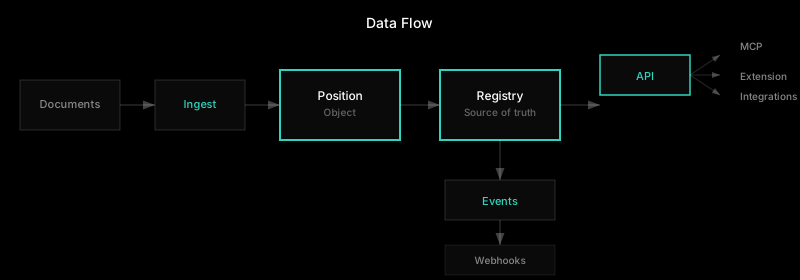

Data Model
Entity relationships and data model for the DMTR platform.
Overview
The DMTR data model defines entities and their relationships. Positions, participants, issuers, vehicles, and registry records form a graph of ownership and rights. Understanding the model is essential for effective API usage and integration design.
Core entities
Position — An ownership interest (SPV LLC interest, fund LP interest, etc.). Linked to participant (owner), asset (issuer + vehicle), and registry. Participant — A legal or natural person who holds positions. Has identity graph data (KYC, AML, accreditation). Asset — The issued security or vehicle. Comprises issuer and vehicle class. Registry — The authoritative record linking positions to entities and ownership state.
Asset
The issued security or investment vehicle referenced by positions.
| Field | Type | Description |
|---|---|---|
| issuer | object | Issuer entity with name, ref, LEI, and jurisdiction |
| vehicle_class | enum | lp_interest | gp_interest | doiv_gp_interest | doiv_lp_interest | doiv_membership_interest | spv_llc | fund_lp | direct | feeder | other |
| underlying | object | Underlying portfolio company (company, sector, security_type) |
| terms_hash | string | SHA-256 hash of governing documents |
| governing_document_id | string | Reference to the Document record for the governing OA |
| vintage | date | Origination or closing date |
Position Object Schema
DMTR Position Object — the canonical representation of a private market position.
Relationships
Positions reference participants (beneficial owner) and assets (what is owned). Assets reference issuers. The registry maintains the graph of entities and their relationships. Transfers create new positions or modify existing ones; the event log captures history.
Extensibility
The model supports multiple vehicle classes and custom attributes. New entity types can be added for specialized workflows. See Registry and Identity Graph for related concepts.